I have always been fascinated by the power of words and the ability of gifted writers to ignite the imagination, fuel the intellect and feed the soul. Reading is the supreme indulgence and perhaps connects us most intimately with what it is to be human, traversing emotions and the very history of mankind.
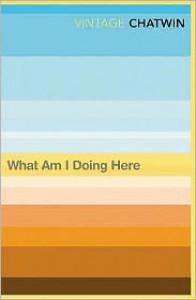
This rather eclectic collection of Chatwin’s writings is simply a great read and a suitable homage to his craft. The breadth of his travel and experience is made to seem almost ordinary, when clearly the writer was anything but. This was my first reading of Chatwin and was purely by chance that the book came my way, but what a feast of language to savour. Must be serendipity.
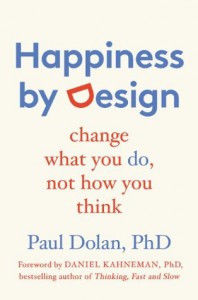
A thoroughly interesting read this was my first dip into the work of Paul Dolan and though it was consistent with what I might have anticipated from a professor at one of our leading academic institutions (assiduously researched and referenced), it was also written in an engaging style that kept the readers attention. Offering some fascinating insights into the components of ‘happiness’, this book enables an individual audit of one’s own happiness and a means to attend more effectively to what matters. At the very least, Dolan encourages reflection on one’s ‘happiness production process’ and suggests that we have the potential to self-promote a greater sense of happiness. A substantial claim, but worth the investment of the time to read and make up one’s own mind.
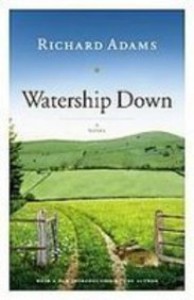
This was one of my course books at school and we pored over the adventures of ‘Fiver’ and ‘Bigwig’, et al and the underlying social systems of the respective burrows. It was one of those classroom unknowns, but discussed at length, whether it was the author’s intention to provide a critique of democracy vs authoritarian rule, or simply a children’s adventure book to be enjoyed. It was not until my thirties that I was able to get a definitive answer from the author, Richard Adams. I was lucky enough to live for a time in the same village, not far from the legendary down and was invited round for tea. Of course, I had to satisfy my curiosity, but it was quite a relief to learn that it can be enjoyed as simply a classic piece of fiction and the news did not diminish it one jot!
An utterly absorbing tale, which sparkles in its creativity and reaches young and older readers alike, with the quality of Pulman’s writing. The characterization is exceptional, the plot intriguing and the pace superb. A modern classic series which really does deserve the description, page-turner.
This was my first introduction to Jack London’s work and I thoroughly enjoyed it. The storyline was gritty and very in keeping with the period and the tough life for pioneers in the wilderness of north america. But, it was also gripping and offered a really satisfying read. On the strength of this book, I aim to read more from this author.
Just after midnight, a snowstorm stops the Orient Express dead in its tracks in the middle of Yugoslavia. The luxurious train is surprisingly full for this time of year. But by morning there is one passenger less. A ‘respectable American gentleman’ lies dead in his compartment, stabbed a dozen times, his door locked from the inside . . . Hercule Poirot is also aboard, having arrived in the nick of time to claim a second-class compartment — and the most astounding case of his illustrious career.
I picked this up while browsing a charity shop’s offerings and notwithstanding my son’s obervation that he had noticed it in the teen section of a nearby bookshop, stuck with it. And I’m glad I did. A good story can afterall be compelling, irrespective of the ‘target audience’ and in August Pullman, Palacio developed a very unlikely, but wonderful hero. The story is cleverly related from a number of different perspectives and engagingly ripples outward from August to family, classmates and wider community and the respective challenges faced by the protagonists. Indeed, the book confronts the discomfort experienced by individuals and in some cases the surrendering to ugly bigotry and crude discrimination. The central theme relates to the judging of books by their covers, but encourages the reader to look beyond the superficial. Moreover, any book that can draw a reader to empathise and contemplate what s/he might do in a given situation and provoke soul-searching is worth the effort. I thoroughly enjoyed reading ‘Wonder’, the language is straightforward and the message is simple. Doing the right thing is sometimes hard, yet as R.J Palacio describes, it can be uplifting. Want a lift – read this study in positive action!
A compelling read, the concept is an intriguing one, the consequences of which underpin an extraordinary connection between the main characters, Henry and Clare. To describe the novel as an “old-fashioned love story’ is to underplay the depth of the examination of attachment and loss, experienced by the main characters. The flitting between time and place and the respective ages of Henry and Clare may be distracting for some, but is deftly handled by Niffenegger. The author makes wonderful use of the latitude afforded by the device of time travel and her narrative is sparklingly inventive, excruciatingly tender and crushing in it’s portrayal of despair. Originally unsure whether this was aimed at female readers, I was blissfully swept up in the story and absolutely enjoyed the book for the quality of the writing and a very thought-provoking premise. Bravo!
I came to this book, mindful of my spiritual frailties and yet, aspiring to better understand how to move forward. In that context, Dave Roberts has provided an inspirational and thought-provoking insight into the development of Ffald-y-Brenin and the foundation of faith, which has enabled the creation of a thriving ‘house of prayer’. Indeed, so engaging was the book that I drove to West Wales to see for myself, such was the allure of the exciting groundswell of activity described. I was not disappointed. Doubtless it helps if the reader is a ‘believer’, but even if not, I fancy one cannot help but be impressed by the sheer dedication and outpouring of faith writ large on the page, which also suggests a courage and conviction which is increasingly rare today. A common charge is of ‘mainstream’ Christianity being a bit ambivalent and less forthright in it’s moral assertions. Whilst this book might not be the antidote, it does at least imply that there remain strong voices, with clear messages, not least concerning the value of prayer and an ongoing need to develop our relationships with God. An uplifting read.
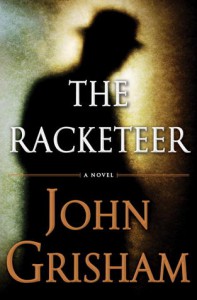
I have come to expect a polished story from JG, pacy and with a concise opening, which hooks the reader from the off. ‘The Racketeer’ fits this pattern and yet in my view it is not one of his best. The plot seemed more contrived than usual and the characters less plausible somehow. I do not regret reading it, in fact I read it voraciously, but even as an erstwhile fan, this book will not be near the top of my favourite Grisham’s.


 BurfoBookish