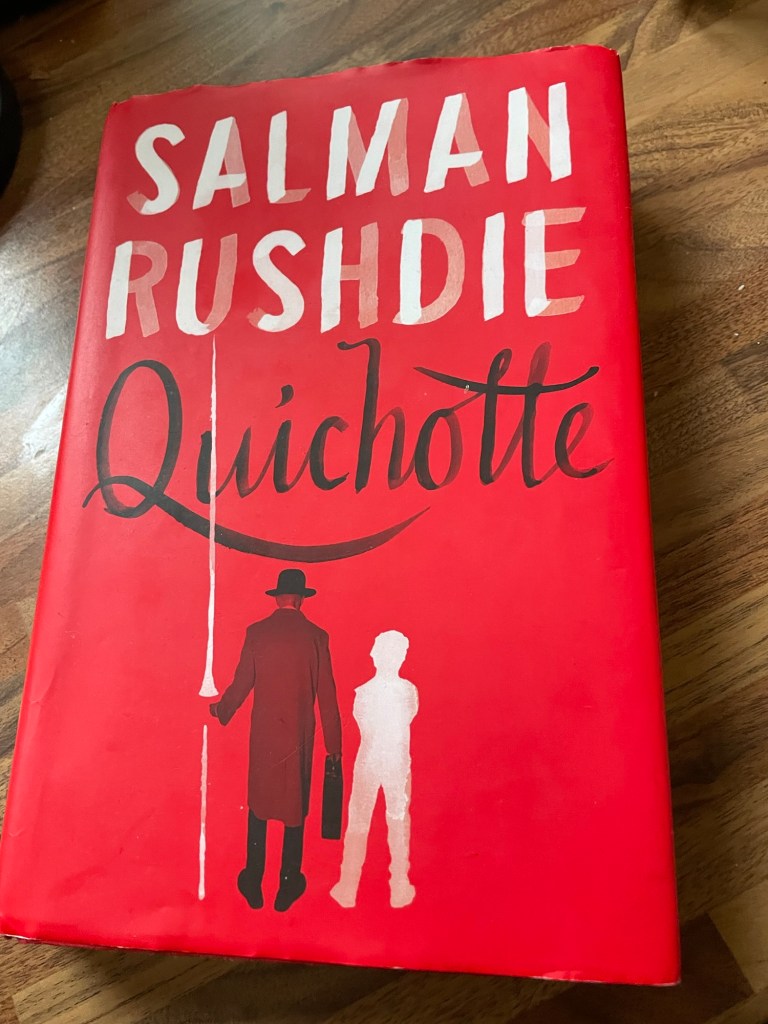
I picked this book up in a charity shop, buoyed by my recent enjoyment of ‘Victory City’ (see October 2024 review) and a vague recollection of my introduction to ‘Don Quixote’ at school. Indeed, Salman Rushdie acknowledges the Cervantes classic provided inspiration and underpinning themes for this contemporary take, but set in modern USA, the journey taken by Quichotte ( pronounced ‘Key-Shot’) plunges the reader into a fascinating and at times surreal odyssey, which explores the very nature of reality in a world where ‘truth’ is so relentlessly contested. Given the gravity of the author’s body of work, the reader was not surprised by the depth of the tale’s scope. However, the evolution of the plot gave the impression of a Russian doll, each layer of the complex story-within-a story providing sumptuous food for thought, yet willing the key characters on through their respective mirages.
In-keeping with it’s illustrious forebear, Quichotte lends itself to cerebral challenge on multiple levels. That the author has taken “a travelling man of Indian origin, advancing years and retreating mental powers” and set him on a romantic quest in pursuit of the most unlikely recipient of his love is curious. That Quichotte’s fictional journey towards his beloved should enable the reader to explore so many strands of contemporary life, meticulously interwoven with the parallel story of ‘brother’ (Sam Duchamp), the author/inventor of Quichotte, so intricately plaited together, tapering to a satisfying and beribboned end, is quite miraculous!
Still, underlying the fiction is also a thinly veiled commentary on the erosion of culture and the apparent willingness of society to be in thrall and to indeed collude with its manipulation. “The world before the birth of the monster the internet became, before the age of electronically propagated hysteria, in which words have become bombs that blow up their users.”
Through the invention of Sancho (Quichotte’s son) the reader is afforded a blank canvas, a child’s eye view, trying to make sense of a confusing world, an ‘age of anything-can-happen’, even when it’s nonsensical. Indeed, Sancho wonders whether the human race is “mistaken, or perhaps deluded, about its own nature. It has become so accustomed to wearing its masks that it has grown blind to what lies beneath…”
The author’s caustic observations tinged with apparent dismay at the immersion of society in ‘junk culture’ and the castigation of its architects, in the guise of Evel Cent, appear to rail against a dementing process underway. In that sense, Quichotte may represent a metaphor for the addled confusion through which he experiences the world. “Yesterday meant nothing and could not help you build tomorrow. Life had become a series of vanishing photographs, posted every day, gone the next. One had no story any more. Character, narrative history were all dead. Only the flat caricature of the instant remained….” Pessimistic perhaps, but at least the existence of love is portrayed as a potentially redeeming possibility.
This reader found the dystopian and acrid dissection of western culture uncomfortable at times and even belying the simple retelling of a classic tale and yet the aftertaste burns and the author may have a point, such perceptions should be unpalatable. Certainly this book forges an extraordinary take on the genre of magical realism. What a fascinating dinner guest Sir Salman Rushie would be!
 BurfoBookish